Description
| A Celtic festival that’s not a clichéd shamrock festooned caricature of Irishness
by Alison Jones
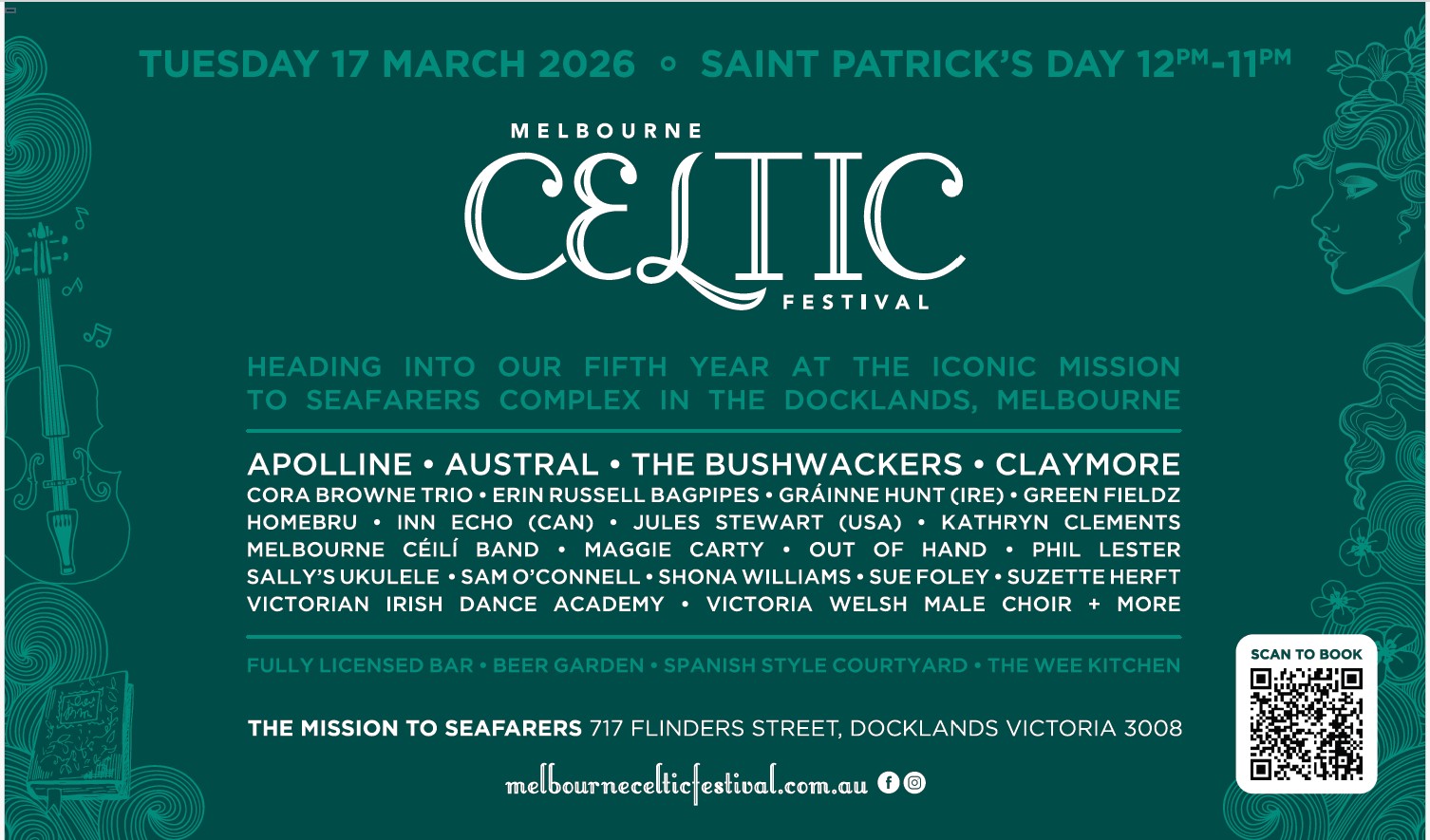
On St Patrick’s Day 2026, Melbourne’s Mission to Seafarers is once again transformed. However, it’s not transformed into some clichéd shamrock festooned caricature of Irishness, but into a living, breathing node of music, culture, and creative exchange that feels as much of this city as it does of the Celtic world. From noon until late, Melbourne Celtic Festival’s four intimate stages, the Hall, the Chapel, the Dome and the Garden Stage, invite you to craft your own journey through contemporary and traditional sounds, rhythms and stories. The festival’s strength this year lies precisely in its refusal to be reductive. Yes, there are reels and jigs aplenty, but there’s also genre bending folk, indie tinged songcraft, and cross-cultural dialogue that speaks to a Melbourne audience familiar with hybridity in music and identity. At its heart this year is a rare blend of international and homegrown talent. You’ll feel that global dialogue from the first note: artists hailing from Ireland, Canada, the USA and across Australia are represented across the lineup. One of the festival’s most compelling moments will be Maggie Carty’s performance, a musician whose ascent marks a distinctive strand in trad music’s evolution. Born in Boyle, County Roscommon, and now based in Melbourne, Carty’s banjo and vocals thread together lineage and reinvention. Her album, ‘Ebb and Flow’, which won Folk Album of the Year (Traditional) at the Australian Folk Music Awards, is a quiet revolution in itself, blending Irish tradition with threads of Americana and Australian folk sensibilities. In a festival landscape too often content with affection alone for older forms, Carty reminds us that tradition lives through reinterpretation and earnest personal voice. While Carty’s artistry is rooted in history and lineage, the festival also amplifies next-gen voices. The Under 30s showcase in The Dome from 5.30pm is a highlight of the day. It’s a slot that doesn’t feel like an afterthought, but a statement of perspective. Here, you’ll encounter the spirited Sam O’Connell, the contemporary folk inclinations of Out of Hand, the intricate harmonies of Apolline, and the genre-blending energy of Homebru, all artists whose work refracts Celtic influence through 21st-century sensibilities. And then there are the heritage acts that anchor the festival’s sense of continuity. The Bushwackers, a group that has been part of Australia’s folk fabric since the early 1970s, bring their distinctive brand of roots and bush music that resonates just as deeply now as it did in the decades of their birth. Their presence reminds us that Celtic music in this part of the world isn’t an import, it has been woven into local expression for generations. The result is a program that feels reflective rather than retrospective. It’s not about staging a kind of Celtic museum. It’s about participating in a tradition that’s still alive, still evolving, and startlingly present in the hands of musicians both seasoned and new. In Melbourne’s lush intersections of culture, immigration and local creativity, this festival doesn’t just celebrate a heritage, it reimagines it. In doing so, it becomes a model for what a trad festival can look like in 2026: inclusive, expansive, and unmistakably now.
|