Description
|
||||||||||||||
|
|
||||||||||||||
|
||||||||||||||
|
||||||||||||||
|
||||||||||||||
|
||||||||||||||
|
||||||||||||||
|
|
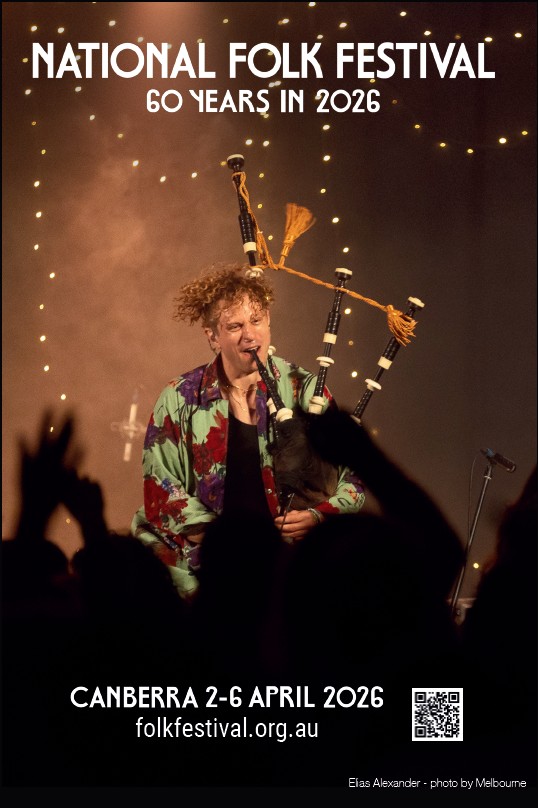
National Folk Festival is an experience like no other
by Michael Sollis
TN168 Jan 25
For decades, the National Folk Festival has been a cornerstone of Australia’s folk music community, a gathering where traditions are honoured, creativity flourishes, and connections are forged.
This Easter, between April 17 and 21, the 2025 Festival promises to uphold its legacy in Canberra while embracing new voices, stories, and experiences.
Whether you’ve been part of the Festival family for years or are considering attending for the first time, there’s something magical about being part of this shared celebration.
The 2025 program showcases a dazzling array of performers, celebrating both established names and emerging talents.
Captivating storytellers such as Josh Pyke, Ruth Moody, and Irish Mythen will perform alongside First Nations voices like Stuart Joel Nuggett and The Stiff Gins to create a powerful and diverse musical landscape.
John Flanagan and friends are bringing their James Taylor show, whilst instrumental aficionados will be treated to performances by the fiddle and harp duo Chris Stout and Catriona McKay, and the dynamic pairing of harmonica virtuoso Will Pound with guitarist Jenn Butterworth.
Dance is woven into the heart of the Festival, offering something for everyone.
The Bridgerton Ball provides an elegant start to the weekend, while the Masked Heritage Ball celebrates the rich history of folk music played in Australia over the last 200 years.
For high energy enthusiasts, the Yankadi African Party and Latin Fiesta promise dynamic beats and vibrant rhythms.
Families can enjoy the Family Bush Dance with the Kameruka Bush Orchestra, and dancers of all levels can join workshops led by inspiring artists.
The National Folk Festival thrives on the spirit of participation.
Sing alongside Ruth Moody in the Festival Choir, or immerse yourself in ensembles like the Festival Mariachi Band and the National Contra Band, which welcome musicians of all abilities.
Whether you’re joining a session, attending a workshop, or simply soaking up the atmosphere, the Festival offers countless ways to connect with the folk community.
In addition to music and dance, the Festival celebrates the power of words.
Marco Gliori, one of Australia’s most beloved bush poets, returns with his signature blend of wit and heart.
Meanwhile, Sassi Spirit brings a spiritual and powerful First Nations perspective through spoken word and song, adding depth and resonance to the Festival’s storytelling traditions.
Whether you’re reconnecting with friends, dancing the night away, or discovering your new favourite artist, the National Folk Festival is an experience like no other.
This Easter, join us at EPIC in Canberra to celebrate, create, and connect.
For tickets and program details, visit folkfestival.org.au.
Federal Government lifeline for National Folk Festival
|
TN167 Dec 24
|
|
|
|
Get your folk on in Canberra
By Kate Edwards
Published in T&N154 Feb 2023
Tickets are now on sale for the 2023 five-day National Folk Festival, headlined by Australian folk rock legends, The Waifs, known for their hits “London Still” (2002), “Bridal Train” (2004) and “Sun Dirt Water”, as well as supporting Bob Dylan on his 2003 Australian and North American tours.
Alongside them will be English singer-songwriter, Billy Bragg, an activist and well known for his hits in the late ‘80s, bringing his musical tales of romance, politics and protest.
Other acts performing over the Easter long weekend include returning favourites Fred Smith, Steve Poltz, Jan Preston, The Pigs, Tony McManus, Apodimi Compania and ARIA Award-winning, Kavisha Mazzella.
The festival will also include: Natalie and Brittany Haas from the USA; storytelling duo, We Mavericks; well-loved local trio Keith Potger, formerly of The Seekers, with Moya Simpson and John Shortis; and all the way from the UK, Chris While and Julie Matthews.
Further adding to the line-up, the festival is excited to host many of this year’s Folk Alliance Australia Folk Music Award winners including: Austral, Winner of Traditional Folk Music Album of the Year; Charm of Finches, Contemporary Folk Music Album of the Year; Fred Smith, Solo Artist of the Year; The Lost Clogs, Community/Cultural Project of the Year; and, Hillbilly Goats, recipient of the People’s Choice Award.
Beyond the world-class performances on stage, the festival will once again offer markets, food, music, craft and dance workshops for adults and children alike, and of course, the famous Session Bar.
Yuma and Winter greetings from Gadigal Country friends of the folk world!
by Katie Noonan
Published in T&N149 July 2022
I hope you and yours are doing well and you are still relishing in the warm memories of gathering on Ngunnawal Country over Easter to find your family, find your home and find your folk.
I have loved seeing all the beautiful pictures and happy reflections, particularly from many new people discovering the festival for their first time.
If you want to fill your heart with goodness, please check out Adam Purcell’s amazing NFF photos here: https://www.melbourneceilicamera.org/browse – his wonderful pics have really filled my heart!
In my life, my aim is to create and curate programmes that mean something.
There needs to be a societal and fundamental ‘why’ behind the programme that gives it a spiritual identity beyond the event itself.
I aim to create programmes that speak to our cultural identity with pride and fervour.
I am a fiercely proud Australian artist living on unceded Aboriginal Country and the National Folk Festival is an Australian festival.
Alongside the oldest Indigenous living culture on the planet, Australian folk come from all over the world and there is no ‘other’, we are all Australian Folk.
I am extremely proud of the inclusive programme we delivered this year, with many folk artists returning home to NFF stages after many years away, and many artists performing for their first time.
In coming to the National Folk Festival, I have been able to help them transition through the difficulties of Covid, to assist them out of the financial issues that this caused and enable them to continue to present a festival in 2022.
The position also enabled me to survive in a time when I was unable to perform/tour and provide for my family, and for that I am very grateful.
This involved putting together a world class programme of Australian only artists and working to enable partnerships with funding bodies such as Australia Council for the Arts, RISE, Events ACT, Visit CBR ($1.1M+), and create other significant sponsorship partnerships.
The few moments I had to enjoy the session bar and watch some of the acts was truly life affirming and heart filling.
Uncle Archie’s extraordinary concert will be with me ‘til my last breath.
It was so incredibly special to host his last ever concert on Ngunnawal Country.
Seeing our 250-voice community choir sing in Ngunnawal language was extraordinarily special, as was raising $15,000 for UNHCR for Ukrainian refugees via our live stream broadcast of the Opening and Closing Concerts with ADCH.
I am very proud to say this was the first charitable donation of this size in the NFF’s 55-year history.
I worked very hard to promote the festival and the diversity of acts to my 85,000+ social networks, and helped secure unprecedented national media coverage for your festival.
I hope this helps to build the festival brand awareness to the wider audience it deserves.
I can honestly say myself and the amazing NFF staff could not have worked any harder.
When I showed up to serve drinks at the volunteer party for a few hours on the Monday night, I was dead on my feet, but alongside my amazing staff-mate Sharmini, I wanted to show my personal thanks to our extraordinary volunteers that made the festival happen.
Like all festivals, the NFF has survived thanks to the herculean efforts of its volunteers.
They are a true testament to the festival’s survival.
I was also very happy to donate my various professional performances pro-bono for the betterment of your festival.
I was very proud to work alongside the NFF staff, but it is now time for me to move on.
I wish the staff, board, and the company members the very best as they navigate a necessary time of change and evolution.
I will leave you with the Oodgeroo Noonuccal poem ‘A song of hope’ from our Opening Concert.
I genuinely hope that the National Folk Festival community can work together towards a glad tomorrow and take inspiration from the word Makarrata, a Yolngu word describing a process of conflict resolution, peacemaking and justice
National Folk Festival Katie style
by Peter James Dawson
Published in T&N148 may 2022
Celebrating its 30th, the National Folk Festival on Ngunnawal country in Canberra was a welcome relief to the huge crowd hungry for the return of live music and dance.
The choirs were vibrant, the dance workshops enthusiastic and the sessions bar pumping until the early hours with numerous jams.
Artistic director, Katie Noonan, must have cloned herself, as everywhere I went, there she was.
Her choice of performers and bands was inspired, involving many First Nations artists, strong women and spiced with multicultural acts, while the colourful Morris dancers were out in force.
The be-stilted Hemlock mastered the myriad of jugglers, acrobats and buskers on the street with ease.
One of the most flamboyant being one-man-band Uptown Brown, and the RareTreats had them eating out of their hands at the food court.
Thursday night, Miriam Lieberman, with little babe strapped on her back, played the West African kora with passion, flanked by a pair of delightful violinists, Lara Goodridge and Susie Bishop.
The other standout on the first evening was Bill Chambers, who sang his tales solo and with an ace band.
I had been looking forward to seeing the Sunshine Coast’s Andrea Kirwin & the Yama-Nui Social Club on Friday’s program, and I was not disappointed.
Songs from her fifth album, BLOOM, sounded as fresh as the day they had been recorded and Andrea referred to her time cutting her musical teeth around Canberra with the Andi & George Band.
Claire Evelynn stroked the strings of her harp with charming delicacy on a couple of early numbers, while 16 year-old Dexter Reed beat the drums with studied professionalism, and Zac Hurren’s sax solos buzzed seductively.
Neil Murray was sadly without former Warumpi Band mate, Sammy Butcher, due to Sammy’s fragile health being aggravated by the Northern Territory justice system decision to acquit the police officer of murdering Kumanjayi Walker in Yuendumu.
Neil sang of his travels and sang a deadly version of the Warumpi classic, ‘Jailanguru Pakarnu’ (Out From Gaol), written with Sammy and the first rock song to be sung in a traditional language, Luritja.
The Opening Concert in the Narragunnawali marquee featured Tibetan maestro, Tenzin Choegyal, Jack Carty, Emma Donovan, Parvyn, with Katie Noonan on keyboard and backing from The Hauptman Trio and the Phoenix Collective string quartet.
Katie led the Phoenix strings in the soaring poem by Oodgeroo Noonuccal, ‘A Song of Hope’, her voice powerful and operatic.
To reinforce the indigenous content in the musical offerings, Uncle Archie Roach sang a passionate duet on his ‘Let Love Rule’ with the very talented youngster, Layla Barnett, who has been mentored by Katie.
Layla has a bright future with a superb voice that did justice to the epic ‘Bapa’ by the late Gurrumul Yunupingu.
She won the NFF’s Gill Rees Award for the most promising young musician.
Will Kepa accompanied Alinta Barlow on guitar, as she superbly rendered Neil Murray’s ‘My Island Home’ in English and the local language, Ngunnawal, to close the concert.
Then the wildly vivacious Kate Cebrano had the audience up dancing as she entertained with numbers from her long career, including songs from her time as Mary Magdalene in Jesus Christ Superstar.
Saturday was the day for Songs of Don (Walker) with Emma Donovan, Catherine Britt, Jo Davie and Katie Noonan (like I said, she was everywhere).
It was marvellous to hear Don’s great compositions rendered by female voices, and as Katie said, “Don always wanted to hear woman sing his songs.”
Aine Tyrrell is a powerful Irish woman, whose 8-minute rap-style piece was in answer to a critical message she received from someone complaining she had no business supporting Black Lives Matter and indigenous causes.
Archie Roach, on his last tour, pulled the biggest crowd of all.
His ardent and heartfelt story-songs enthralled, with tears streaming down his cheeks when he introduced a song about youth suicide.
‘Down City Streets’, written by his wife and soulmate, Ruby Hunter, brought more emotions to bear and he explained how he had discovered her songwriting by chance and it had become the final track recorded for his debut album, ‘Charcoal Lane’.
High Ace duo, Jeff Lang and Alison Ferrier, were playing in the huge main marquee as I strolled back from a late lunch at my campsite.
Jeff’s lap steel notes drifted across the oval penetrating the general hum of the festival.
Parvyn, having launched her debut album at Melbourne’s Malthouse Theatre on February 3, had already played WOMADelaide and CresFest before her four appearances at the National.
These included the Opening Concert and Songs of Joni (Mitchell).
Her accomplished band members were guitar and mandolin virtuoso, Josh Bennett, the versatile Andrew Clermont on fiddle, and smooth double bassist, Holly Downes.
After more than a decade fronting Bollywood funksters, The Bombay Royale, Parvyn was wearing her heart on her sleeve as she delivered up honest ditties, like ‘What You See’, about her own life and her struggle with depression and jealousy.
Questioning love song, ‘R U My Love’, the mysterious ‘Sa’ and romantic ‘Something 29’ flowed off the stage enveloping the audience in a sonorous hug.
Parvyn was joined for her second concert by the sweet harmonies of Pia Nesvara and Chev Person from the Melbourne Songwriters Collective.
Last band on the main stage on Saturday was soul diva Emma Donovan & The Putbacks, with tunes from the band’s two albums, Crossover and Under These Streets.
A highlight was her poignant tribute to the late Aunty Ruby Hunter, by singing her Ngarrindjeri language ballad, ‘Yarian Mitji’, that simply translates as, “What is my story?”
A second soulful Emma Donovan & The Putbacks gig was on Sunday night when she dedicated a song to the budding young Gubbi Gubbi singer, Layla Barnett.
Sunday saw Linsey Pollak entertain with his own version of exotic European woodwinds.
He is a wizard with reed instruments and his show included a detailed account of his time in Macedonia, where he met Romany musicians.
This inspired him over the past three decades to invent and make, “dozens of wind instruments such as the saxillo, gaidanet, watering can clarinet and carrot clarinet, Mr and Mrs Curly (contra bass clarinets), Crow (a narrow bore bass clarinet made from Crows Ash) and dozens of variously tuned clarinis (keyless clarinets)”.
Tenzin Choegyal, who had got the audience to shout out their stress at the Opening, where he played with the Phoenix Collective, performed a solemn solo set.
He spoke of the mothers damaged by wars and the love of his own mum, plucking his dramyin lute fiercely and singing with a voice like thunder.
I caught a second performance of Andrea Kirwin & the Yama-Nui Social Club, with guest violinist, Gareth Mew, who blazed a meteoric couple of solos.
I wandered in on the Folk Fellowship Showcase in time for 2020 Fellow, Luke Byrnes, to explain his project collecting old songs in the Northern Rivers region of New South Wales.
Bandaluzia Flamenco had me on the edge of my seat as the incredible dynamic moves of the two dancers entranced me with their flowing elegance of arm gestures, to the pounding rhythmic exactitude of their footwork.
Led by flamboyant guitarist, Damian Wright, whose hands moved faster than a speeding bullet, Jessica Statham and Rosalie Cocchiaro showed immense strength and stamina in their performance.
Cigany Weaver is the vehicle for the four-octave range of Jo Davie’s amazing voice, with bandmates producing extended solos on violin, bass and guitar.
Grinning from ear to ear, Jo sat at the feet of each soloist when not leaping energetically about the tiny Scrumpy stage.
The Closing Concert, featuring several of the festival artists, was themed Songs of Unity and Treaty, and focused on the Warumpi Band’s hits, ‘Blackfella Whitefella’ and ‘My Island Home’.
Neil Murray & the Folk Festival choir, conducted by the effervescent Stephen Taberner, led the throng in a joyous celebration.
The finale came when Yothu Yindi took the main stage as several ochred dancers prowled ferociously back and forth, a yidaki (didjeridu) droning and bilma (clapsticks) clacking.
As the band cranked up the electricity, the crowd surged forward to dance.
Original bassist and musical director, Stu Kellaway, with long-time drummer, Ben Hakalitz, thumped out a steady rhythm.
Stu’s son, Roy Kellaway, ripped off some fabudeadly guitar solos throughout the playlist of Yothu Yindi classics.
As it is the 30th anniversary of the band’s ‘Treaty’ and the 30th National Folk Festival, it was essential that the song was played, and it virtually brought the house down, with Jodie Cockatoo Creed singing her heart out and dancing up a storm.
Luckily, it was not too late at night and the crowd insisted on an encore, so with the grandson of the late Dr M. Yunupingu, lead singer, Rrawun Maymuru, stalking the stage, Yothu Yindi obliged with a couple including ‘One Blood’.
For the Opening and Closing concerts, plus the curated shows, featuring songwriters, Don Walker, Joni Mitchell and Judy Small, The Hauptman Trio was the very competent, tenacious backing band.
Siblings, Zoe on bass, guitarist Ben and drummer James are Canberra locals and were tirelessly professional and played with aplomb.
With so many overlapping great acts, I only caught a glimpse of the country songstress, Catherine Britt, the quirky, Penelope Swales & the Stranded Assets, vibrant, Franco-Moroccan MZAZA, comic activist, Omar Musa, genre-blending Chaika and the multi-discipline artist, Josh Pike, all doing a great job.
All in all, everyone was very happy to be back at a festival, whether player or punter.
, an acknowledgement of the wrongs of the past and moving forward together.