Description
Nick Charles – My Place
CD review by Tony Smith
TN130-27 – $25
TN176 Mar 26
Nick Charles is a world class exponent of finger picking guitar.
He has been recognised internationally for his superb playing style and for his dedication to ensuring that the best tunes are preserved and enjoyed.
Among a string of awards, his win in the 2025 International Blues Challenge in Memphis for best guitar solo is perhaps the most prestigious.
In this 1999 album, there are tunes by Joni Mitchell, J.D. Laudermilk, Doc Watson, Bernie, Pinkard & Casey and Guy Wood & Robert Merlin.
But Charles’ own compositions lose nothing in comparison with these classics.
The Charles originals on this album are ‘Dusty Ribbon’, ‘High Tide’, ‘The Jazzy Rag’, ‘Bibury Court’, ‘Everyday Blues’, ‘Blues for Helen’, ‘Davey Street’ and ‘Prayer for Les’.
In ‘Dusty Ribbon’ you can hear the influence of flamenco style.
Charles describes this as a country minor thing and it does evoke the rural road well.
In ‘The Jazzy Rag’, he uses some mandolin to highlight the offbeat influences.
A nice feature of the sleeve notes is that Nick supplies the capo settings.
So for example, the key of D is attained with the capo on the second fret.
Guitarists seeking to emulate Charles will appreciate knowing the best way to achieve his runs, in this case, with C fingerings.
In ‘Both Sides Now’, Nick takes Joni Mitchell’s melody and gives it his own interpretation based on Randy Scruggs’ style.
In Laudermilk’s ‘Windy and Warm’, he shows his skill in creating a ‘hybrid’ of the many recorded versions.
For this tune he used the capo on the third fret, taking the A minor fingerings into Cm.
‘Bibury Court’ references a Tudor mansion in the Cotswolds.
Nick describes this as a ‘semi-classical’ piece and it shows that he would have excelled in the classical guitar if he chose to concentrate on that style.
It is a sweet contemplative piece.
Nick’s ‘Everyday Blues’ shows some of the techniques that first set his ‘fingers in motion’.
It evokes an image of someone communing with a stride piano.
Bernie, Pinkard and Casey’s swing staple, ‘Sweet Georgia Brown’ ,follows naturally.
Guy Wood and Robert Merlin’s ‘My One and Only Love’ gets a slow, soulful treatment.
In ‘Blues for Helen’, Charles expresses his admiration for the way that Duke Ellington’s style of blues and rag progressions opened musical doors for him.
‘Davey Street’ is an earlier Charles composition which he revisits in a different style.
There is no end to his versatility and creativity.
Nick’s interpretation of Watson’s ‘Doc’s Guitar’ hurries along.
Finally ‘Prayer for Les’ is dedicated to Nick’s first guitar teacher, who gave him the good advice ‘Keep it short, and sweet’.
These tracks make it clear that Nick Charles took the advice to heart.
You can’t help but wish that these tunes would go on longer.
The double bass here is by Howard Cairns, while Nick plays guitars and mandolin.
Although Nick Charles’ playing seems effortless, there remains a humility in his style.
He never gives the impression that he is showing off and always treats the material he has inherited in the blues tradition with respect.
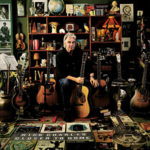
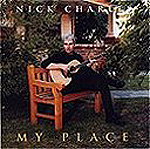
The photos on the sleeve of this album were taken in a garden and a kitchen, and while it might be tempting to make puns about this maestro knowing his place, these thirteen tracks give an intimate view of Nick Charles’ music.
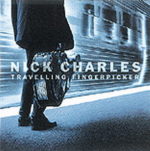
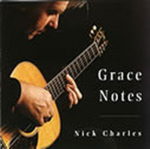
Ed. Nick Charles has nine albums available for sale from the Trad&Now website.
Tracks from all nine albums may be heard from time to time on Trad&NowLive!
He has been invited to and performed at the Edinburgh Festival and supported a ‘who’s who ‘ of musical visitors to this country from B.B King to Guy Clark.
A winner of the Australian Songwriters Competition and ‘Roots Album of the Year’ Award, Nick Charles is known for both his instrumental virtuosity and original compositions.